


The Commander of the Mining Marshals of the Nigeria Security and Civil Defence Corps (NSCDC), Assistant Commandant of Corps Attah John Onoja, has called for stronger inter-agency collaboration, intelligence sharing and joint security operations, warning that rivalry among security institutions could undermine efforts to address Nigeria’s security challenges.
Onoja made the call while delivering a lecture at the RazorNews Inter-Agency Cooperation Lecture and Awards 2026, held on Friday, November 27, at Shoregate Hotel, Ikeja, Lagos. The event featured the theme, Inter-Agency Synergy for National Security: Strengthening Intelligence Sharing and Joint Operations.
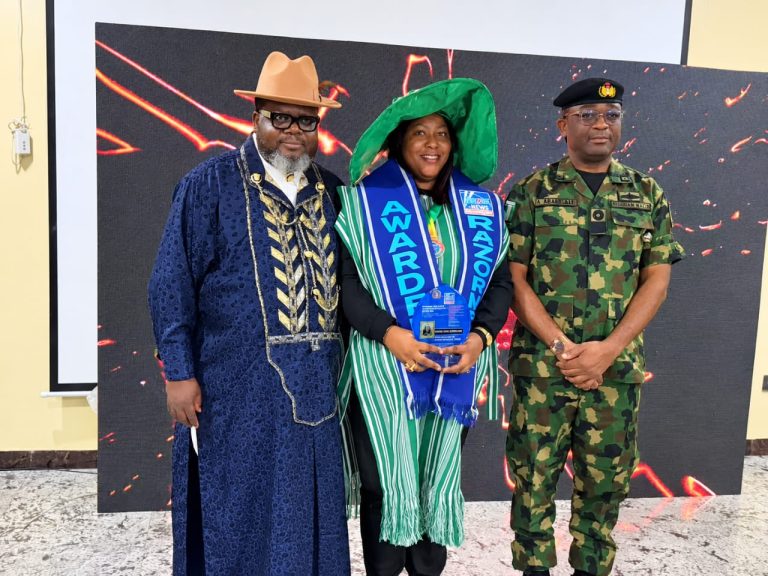
The NSCDC commander, who received the RazorNews Outstanding Paramilitary Officer of the Year Award, said inter-agency cooperation must move beyond speeches at public gatherings to become an established practice in the daily operations of security institutions.
Representing the Commandant General of the NSCDC, Professor Ahmed Abubakar Audi, Onoja conveyed his principal’s appreciation to the organisers, Razor Media Group, led by Odita Sunday, for recognising the contributions of security institutions to national safety and development.
He also acknowledged the Inspector General of Police for demonstrating the importance of institutional cooperation, recalling his historic visit to the NSCDC Commandant General. According to him, the gesture reflected a departure from institutional rivalry and demonstrated that effective security management requires mutual respect among agency heads.
Speaking on the practical application of inter-agency synergy, Onoja said Nigeria’s security architecture should be understood as an interconnected system in which every institution has a distinct responsibility but depends on the effectiveness of others to achieve national security objectives.
Drawing from the sociological theory of structural functionalism, he explained that institutions such as the Nigeria Police Force, Nigerian Army, Nigerian Navy, Nigerian Air Force, NSCDC, Nigeria Immigration Service, Nigeria Customs Service, National Drug Law Enforcement Agency, Department of State Services and other intelligence organisations must operate as complementary components of one national security structure.
He warned that when security agencies operate independently without adequate coordination, intelligence exchange or operational support, the resulting institutional gaps could weaken the country’s collective response to threats. He therefore advocated a shift from vertical operational practices to a horizontal approach that encourages cooperation across agencies.
Citing the Mining Marshals’ recent operations as an example, Onoja disclosed that the Nigerian Army handed over 15 suspected illegal miners to the NSCDC after an operation. He said the Army subsequently supported the investigation, led the Mining Marshals to the crime scene and provided statements from its arresting officers to strengthen the prosecution.
He disclosed that the Federal High Court in Abuja, presided over by Justice Ofili-Ajumogobia, convicted the 15 suspects on November 24, following diligent prosecution, sentencing them to various prison terms and fines. He said the NSCDC would communicate the outcome of the case to the Army Headquarters as part of the reciprocal responsibility required in effective inter-agency relations.
The commander also recounted an operation in Koguna Local Government Area, where his team encountered officers of the Nigeria Police Force during a security assignment. Rather than allow jurisdictional disagreements to disrupt the operation, he said he engaged the senior police officer present, resolved the operational concerns and ensured that both teams worked together successfully.
According to him, the encounter developed into a cordial working relationship, with officers maintaining contact and exchanging information even after the operation. He said the experience demonstrated that mutual respect and professional communication could prevent unnecessary confrontation among security personnel.
He further cited a joint operation in Yauri, Kebbi State, involving the DSS, NSCDC and Nigeria Police Force, which he said benefited from the adoption of community engagement principles associated with the Nigerian Navy’s civil-military relations approach. The strategy helped secure the cooperation of traditional rulers and residents, contributing to the operation’s lasting success.
Identifying the major obstacles to effective inter-agency cooperation, Onoja listed institutional rivalry, excessive attachment to individual mandates, poor intelligence sharing and inadequate patriotism. He argued that personnel must understand that respecting another agency’s statutory responsibility does not diminish their own authority but strengthens the country’s overall security framework.
He stressed that security agencies must respect jurisdictional boundaries and promptly transfer matters outside their mandates to the appropriate institutions. Using illegal mining operations as an example, he explained that when suspects are arrested with dangerous drugs, the Mining Marshals should document the discovery, hand the suspects or relevant evidence to the appropriate drug enforcement agency and request feedback on subsequent action.
Onoja also challenged security personnel to place national interest above personal benefits, ethnic considerations and institutional loyalties. Reflecting on Nigeria’s independence struggle, he referenced nationalist Anthony Enahoro’s historic motion for self-government in 1956, describing the courage and patriotism behind the country’s independence movement as values that should guide public officers today.
He observed that Nigeria’s economic security was inseparable from national security, particularly in the protection and legitimate exploitation of mineral resources. According to him, illegal mining, inadequate resource monitoring and unaccounted mineral movements deprive the country of revenue that could support development and reduce dependence on federal allocations.
The NSCDC commander consequently advocated joint training programmes, intelligence-sharing platforms, coordinated operations, strict adherence to the rule of law and the establishment of practical cooperation frameworks across security institutions. He cited the recent participation of Mining Marshals personnel in a simulation exercise at the Armed Forces Command and Staff College, Jaji, as an example of the benefits of joint professional training.
Congratulating Lagos State on its progress in joint security operations, Onoja urged other states to adopt similar collaborative approaches. He maintained that cooperation, collaboration and coordination, which he described as the three Cs of effective security management, must become operational principles rather than ceremonial expressions.
He concluded that Nigeria could achieve a more effective and responsive security system if personnel across all agencies embraced patriotism, professional discipline, mutual respect and collective responsibility. He thanked the organisers and participants, reaffirming that national security could only be strengthened when security institutions recognised that their different mandates ultimately served one country.




Join the conversation
No comments yet. Share your thoughts and start the conversation.
Leave a comment