

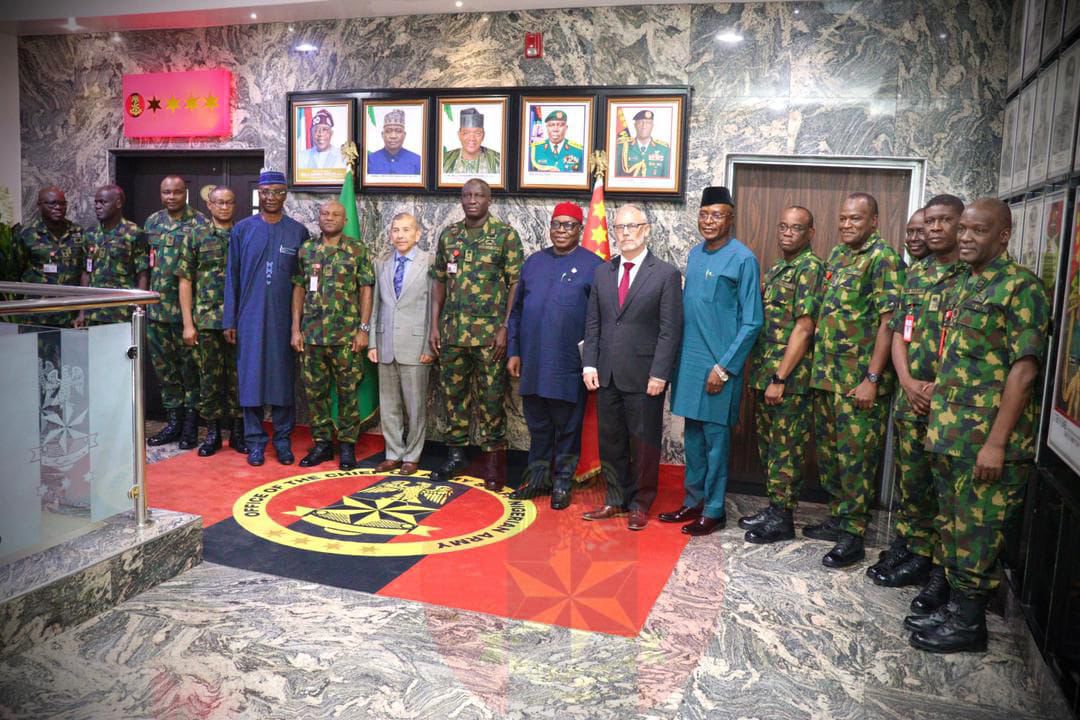
The Nigerian Army has intensified its strategic partnership with the Defense Security Cooperation University (DSCU), a move aimed at strengthening professional military education and boosting institutional capacity to confront evolving security challenges.
The Chief of Army Staff, Lieutenant General Waidi Shaibu, reaffirmed the Army’s commitment to deeper collaboration with international defence institutions when a delegation from the DSCU Nigeria Programme paid him a courtesy visit at the Army Headquarters in Abuja on March 6, 2026.
In a statement issued by the Acting Director of Army Public Relations, Colonel Appolonia Anele, the Army chief emphasised that professional military education remains a critical pillar in building a modern, responsive and highly adaptive fighting force capable of addressing Nigeria’s complex security landscape.
Shaibu explained that the Nigerian Army would continue to subscribe to relevant DSCU training programmes, particularly those focused on defence management, logistics systems and institutional reforms designed to enhance operational efficiency within the Service.
According to him, exposing officers and soldiers to specialised international training platforms would significantly sharpen strategic thinking, strengthen defence administration and deepen institutional knowledge across the Army.
He stressed that such exposure was vital for preparing military personnel to effectively manage the intricate operational and administrative responsibilities demanded by contemporary warfare and modern security operations.
Leading the visiting delegation, retired Major General Miguel Casteyanoss explained that DSCU’s engagement with the Nigerian Army is primarily targeted at strengthening institutional capacity among partner nations.
Casteyanoss noted that the university provides specialised courses and advisory support aimed at improving defence governance, logistics coordination and strategic policy development within partner military institutions.
He added that the collaboration also involves initiatives designed to improve key institutional systems, including material readiness reporting structures and comprehensive life-cycle management frameworks for military equipment.
The retired general expressed optimism that sustained participation of Nigerian Army personnel in DSCU programmes would significantly reinforce professional standards, strengthen institutional resilience and enhance the long-term operational capability of the Nigerian Army.