

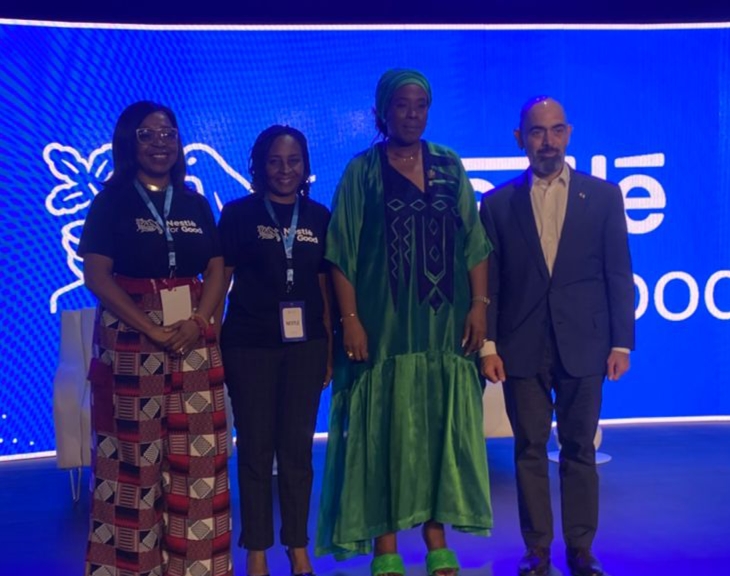
Stakeholders across government, healthcare, academia, civil society, development agencies and the private sector on Thursday gathered in Lagos for the 2026 Nestlé for Good Summit, where calls intensified for a complete transformation of Nigeria’s food and health systems.
The summit moved beyond traditional nutrition conversations as participants advocated integrated solutions linking agriculture, public health, environmental sustainability, economic inclusion and community resilience.
Convened by Nestlé Nigeria Plc, the event became a major policy and development platform focused on the future of food systems and sustainable livelihoods in Nigeria.
Discussions centred on how stronger collaboration among public institutions, private organisations and development partners can improve nutrition outcomes while strengthening supply chains and protecting the environment.
Participants argued that Nigeria’s food security crisis can no longer be addressed through isolated interventions, insisting that coordinated reforms are urgently required across multiple sectors.
The summit also examined how climate challenges, inflationary pressures and weak food distribution systems continue to threaten household nutrition and economic stability.
During a fireside session, the Head of Corporate Communications, Public Affairs and Sustainability for Central and West Africa at Nestlé, Patricia Ekaba, described the Nestlé for Good initiative as a strategic movement designed to deepen social impact and transparency.
She explained that the campaign reflects the company’s commitment to communities, nutrition, environmental responsibility and sustainable development beyond commercial interests.
According to her, the initiative aligns with Nestlé’s Creating Shared Value model, which seeks to connect business growth with measurable social and environmental progress.
Ekaba noted that the programme has continued to amplify real life stories of individuals and communities positively impacted through Nestlé interventions across West Africa.
She cited examples from Côte d’Ivoire and Ghana where beneficiaries reportedly regained economic stability, dignity and renewed confidence through livelihood support programmes.
She stressed that the company’s long running interventions should not be mistaken for short term philanthropy, describing them instead as structured investments in sustainable development.
The Managing Director and Chief Executive Officer of Nestlé Nigeria Plc, Wassim Elhusseini, broadened the conversation by emphasising the importance of systems thinking in tackling nutrition challenges.
Elhusseini said nutrition outcomes are directly tied to the efficiency and sustainability of entire food ecosystems rather than products alone.
According to him, food security begins from the farm level and extends through processing, distribution, environmental management and household accessibility.
He disclosed that Nestlé’s interventions in regenerative agriculture, youth empowerment, water conservation and circular production systems are aimed at building resilient communities.
The summit also drew strong policy perspectives from the Lagos State Government, particularly on the need to guarantee affordable and accessible nutrition for vulnerable populations.
In her keynote address, the Lagos State Commissioner for Commerce, Cooperative, Trade and Investment, Mrs. Folashade Ambrose Medebem, stressed that food systems must simultaneously deliver availability, affordability and accessibility.
She warned that food security efforts would remain ineffective if nutritious food remains beyond the reach of millions of households struggling with rising living costs.
Ambrose Medebem called for stronger alignment between policy frameworks, investment flows and market systems to support long term national food security objectives.
She maintained that collaboration between government institutions and private investors remains critical to sustainable economic and nutrition reforms.
On the agricultural front, Agric Services Manager at Nestlé Nigeria Plc, Edwin Aguda, disclosed that the company’s grains programme in Northern Nigeria is helping integrate smallholder farmers into formal supply chains.
Aguda revealed that more than 18,000 farmers are currently participating in the initiative, with projections to expand the number to 25,000 by 2027.
He described the programme as a strategic intervention aimed at improving rural livelihoods while boosting local food production capacity.
Participants at the summit noted that strengthening local agriculture remains essential to reducing Nigeria’s dependence on food imports and volatile international supply chains.
Environmental sustainability also featured prominently during the summit as experts highlighted growing concerns around waste management and climate resilience.
Sustainability Manager at Nestlé Nigeria Plc, Chinwe Obi, said sustainability initiatives are now embedded within the company’s operational strategy.
She disclosed that Nestlé Nigeria has incorporated 50 per cent recycled plastics into its water bottle production process as part of efforts to reduce environmental pollution.
Obi further revealed that the Food and Beverage Recycling Alliance has expanded significantly from four organisations to approximately 43 participating bodies.
According to her, the alliance has recovered over 400,000 tonnes of plastic waste since 2019 through coordinated recycling interventions and partnerships.
The summit’s technical panel session shifted attention toward growing public health concerns linked to malnutrition and changing dietary patterns across Nigeria.
The session, themed “Nutrition Across the Life Stages: Closing Nutrition Gaps Through Coordinated Approach,” examined the increasing burden of both undernutrition and lifestyle related diseases.
Programme Team Lead at the Nutrition Society of Nigeria, Amaka Nwaora, raised alarm over rising cases of anaemia among women and stunted growth among children.
Health experts at the summit also warned that obesity, diabetes and hypertension are rapidly increasing due to poor dietary habits and weakened food systems.
Panelists argued that Nigeria is currently battling a dangerous double burden involving both undernutrition and non communicable diseases.
They identified weak policy implementation, fragmented institutional coordination and inadequate financing as major obstacles affecting national nutrition programmes.
Beyond food and health discussions, the summit highlighted the importance of human capital development and economic empowerment initiatives.
Several beneficiaries shared testimonies of transformation through skills acquisition, entrepreneurship support and vocational training programmes.
A trader, Titilayo Abene, explained how financial literacy training strengthened her business confidence and improved her economic independence.
A dairy sector beneficiary also narrated how structured support programmes helped stabilise rural value chains and household income generation.
Another participant who graduated from the Nestlé Technical Training Centre recounted how an 18 month programme enhanced technical expertise, leadership capacity and industrial sustainability knowledge.
The trainee also spoke about gaining international exposure in Switzerland with specialised training focused on emissions reduction and sustainable industrial practices.
The summit eventually concluded with a strong consensus that Nigeria’s food and nutrition challenges demand integrated and long term systems reforms.
Stakeholders collectively called for improved policy execution, sustainable financing mechanisms and stronger public private partnerships to accelerate development.
They identified investments in maternal and child nutrition, climate smart agriculture, youth empowerment and environmental sustainability as critical pillars for Nigeria’s future growth and resilience.