

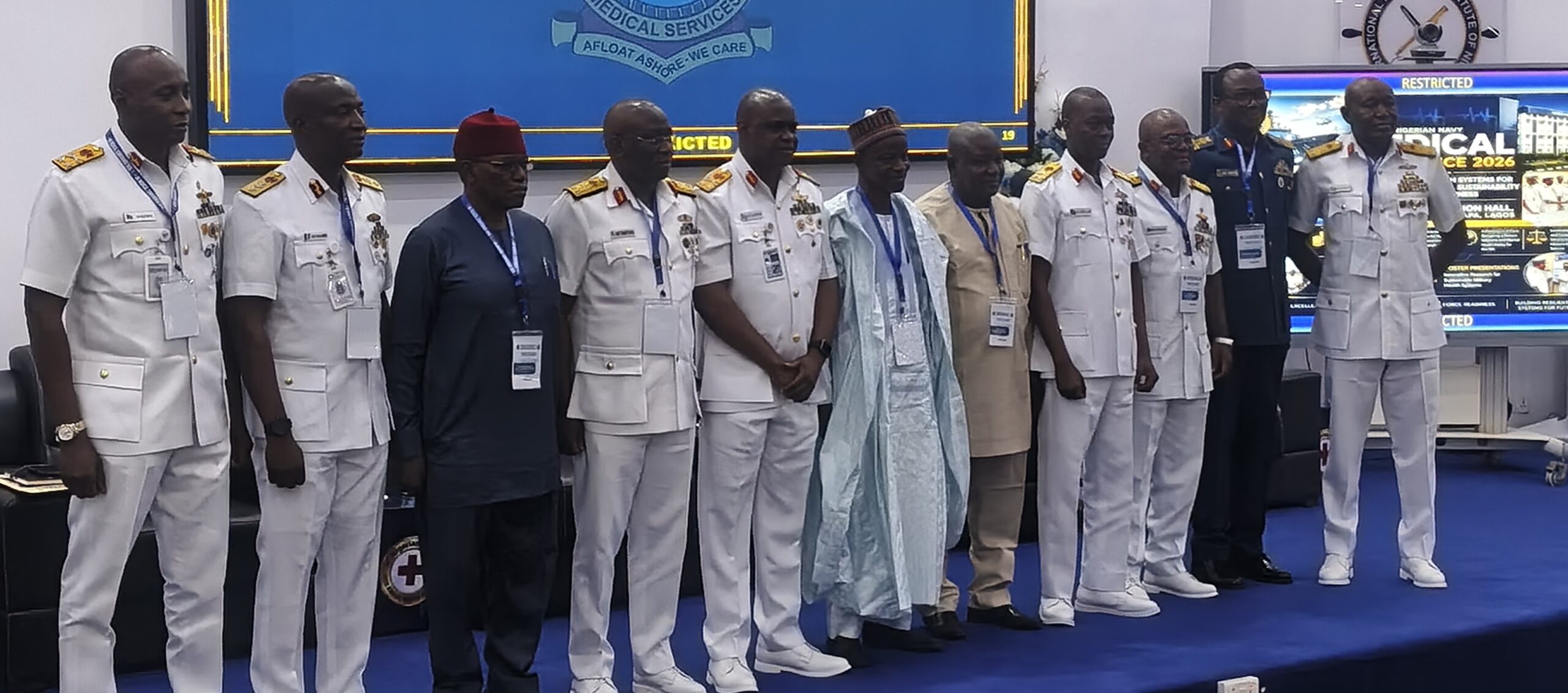
The Nigerian Navy has unveiled an ambitious roadmap to strengthen its healthcare system as part of broader efforts to improve operational readiness, personnel welfare and long-term sustainability across the Service.
Speaking at the 2026 Nigerian Navy Annual Medical Conference held at the IMION Auditorium, NNS Quorra, Lagos, the Chief of the Naval Staff, Vice Admiral Idi Abbas, represented by the Chief of Policy and Plans, Rear Admiral Olatunde Olodude, underscored the strategic importance of military healthcare to naval operations.
He noted that while the Navy’s primary responsibility remains the protection of Nigeria’s maritime domain, the effectiveness of every mission ultimately depends on the health and resilience of personnel.
According to him, combat readiness is inseparable from medical readiness, making healthcare a critical pillar of operational success and national security.
The naval chief said the conference was approved without hesitation because the wellbeing of officers, ratings and their families directly influences morale, productivity and mission effectiveness.
He recalled that as the Nigerian Navy marked its 70th anniversary, the Service had recorded remarkable growth not only in fleet expansion and maritime security operations but also in medical infrastructure and manpower development.
Tracing the evolution of naval healthcare, he stated that the medical service had grown from two modest sickbays established decades ago into a nationwide network of hospitals, medical centres and specialist facilities equipped to handle complex medical and surgical procedures.
He added that the Nigerian Navy Medical Services had attained standards comparable to global best practices but acknowledged the need for continuous reforms to sustain progress and close existing gaps.
The conference, themed “Strengthening the Nigerian Navy Health System for Operational Excellence, Sustainability and Force Readiness,” was designed to generate practical solutions to emerging healthcare challenges within the military environment.
Vice Admiral Abbas highlighted ongoing investments, including the construction of the Nigerian Navy Reference Hospital in Abuja and the expansion of the Nigerian Navy Reference Hospital in Ojo, Lagos.
He expressed confidence that the projects would significantly improve access to specialist healthcare services for personnel and their dependants while enhancing the Navy’s overall medical capacity.
The Chief of Naval Staff tasked participants to develop actionable recommendations on institutional restructuring, healthcare financing, manpower retention and mental health support.
He stressed the need for innovative funding models capable of sustaining world-class healthcare delivery without imposing excessive financial pressure on the Service.
Particular attention, he said, should be given to strategies aimed at reducing the growing attrition rate among medical personnel through improved career satisfaction and professional development opportunities.
He also called for the formulation of a comprehensive veterans and mental health policy that addresses operational stress, post-traumatic stress disorder and burnout among healthcare professionals and serving personnel.
Earlier, the Director of Medical Services, Surgeon Commodore M.J. Salihu, described the conference as a landmark gathering of healthcare experts, military leaders, researchers and policymakers committed to advancing military medicine.
Salihu disclosed that the Nigerian Navy Medical Services had expanded from two sickbays in 1963 to a robust healthcare network comprising reference hospitals, hospitals, medical centres, a medical training school and numerous shore based and afloat medical facilities.
According to him, the medical branch currently boasts 356 officers, including 64 consultants, alongside 2,633 medical ratings deployed across the country.
He said the growth has enabled the Navy to provide quality healthcare not only to serving personnel and their families but also to civilians within areas of operation.
The Director of Medical Services noted that the conference would examine key issues such as institutional autonomy, sustainable health financing, workforce retention, veterans welfare, ethical leadership and psychological wellbeing.
He described a strong healthcare system as a strategic force multiplier that directly contributes to combat effectiveness, mission success and national security.
A major highlight of the conference was the vigorous debate on granting greater autonomy to the Nigerian Navy Medical Services.
The Flag Officer Commanding Western Naval Command, Rear Admiral Abubakar Mustapha, argued that enhanced autonomy would improve efficiency, strengthen accountability and provide medical institutions with the resources needed to meet growing demands.
He advocated legislation that would grant military medical services direct budgetary access, similar to specialised commands within the Armed Forces, while maintaining strong oversight mechanisms.
Mustapha said greater financial independence would enable hospitals to upgrade facilities, support specialist training and reduce pressures that often affect healthcare delivery.
Drawing comparisons with leading military medical institutions abroad, he maintained that autonomy remains critical to building a resilient and responsive healthcare system.
Also contributing to the discussion, the Commander of the Maritime Guard Command at the Nigerian Maritime Administration and Safety Agency, Commodore Reginald Adoki, said the Navy’s medical branch had long surpassed the benchmarks required for institutional independence.
He observed that the expansion of facilities, specialist manpower and healthcare responsibilities over the past two decades had strengthened the case for elevating the medical service into a fully recognised branch within the Navy structure.
Adoki, however, urged stakeholders to carefully consider the nomenclature and organisational implications of such reforms to ensure alignment with naval traditions and administrative realities.
The Chief of Administration at Naval Headquarters, Rear Admiral Jonathan Mamman, expressed support for greater autonomy but insisted that the medical branch must first strengthen its internal structure.
He called for the establishment of specialised directorates covering areas such as aviation medicine, pharmaceutical sciences, nursing services and occupational health to support a more comprehensive institutional framework.
Mamman maintained that the medical service had reached a stage where it could evolve into a stronger and more independent professional branch capable of driving healthcare innovation across the Navy.
Participants agreed that the future effectiveness of the Nigerian Navy would depend not only on ships and weapons but also on a resilient healthcare system capable of protecting the physical and mental wellbeing of personnel.
As deliberations continue, expectations remain high that the conference will produce far-reaching recommendations capable of transforming military healthcare, improving force readiness and positioning the Nigerian Navy Medical Services among the leading military health systems in Africa.