

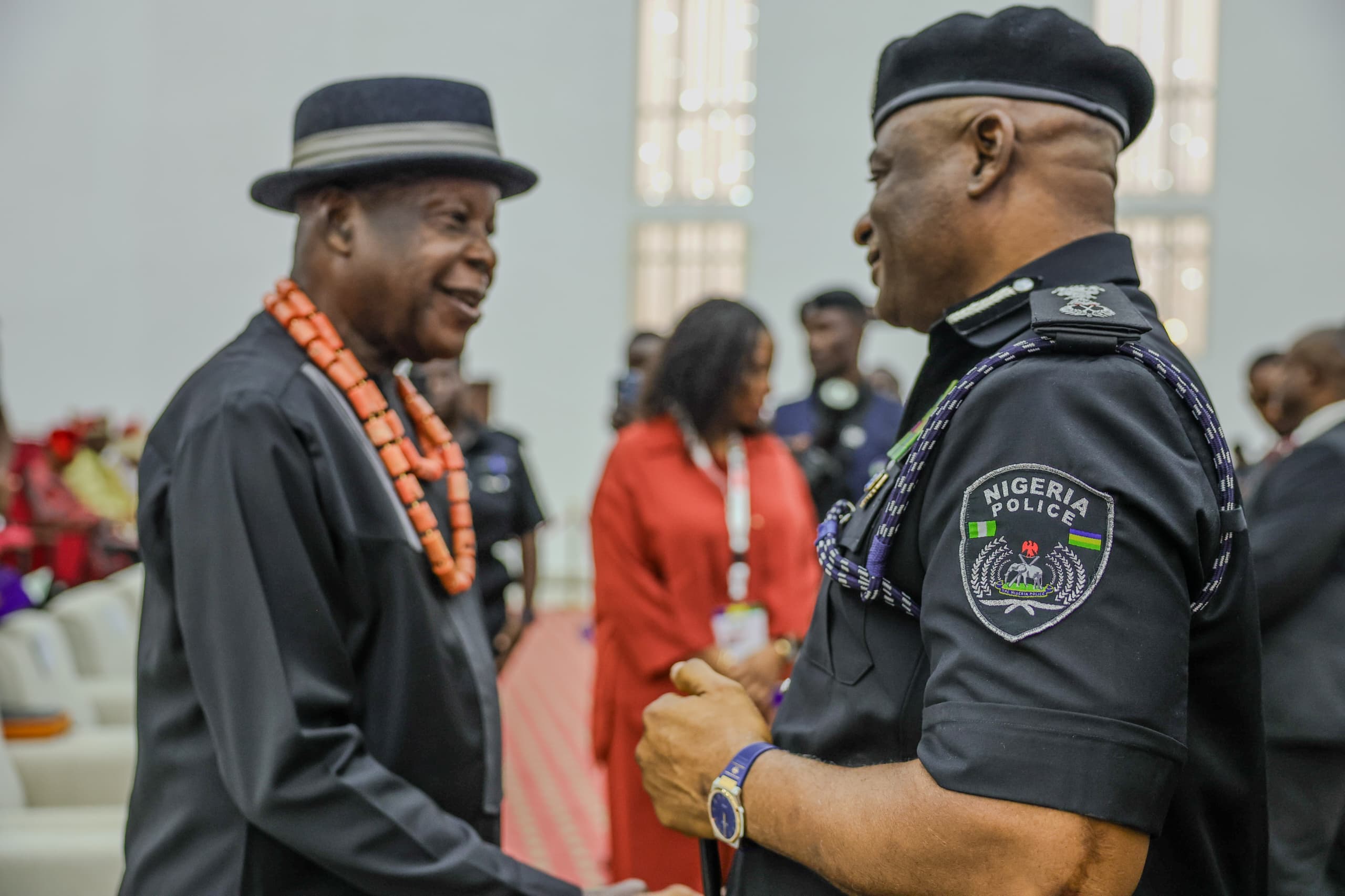
Retired Inspectors-General of Police Mike Okiro and Usman Alkali Baba, alongside the Police Service Commission (PSC), have called on the Nigeria Police Force to develop a comprehensive and practical security roadmap for the 2027 general elections, warning that emerging threats range from criminal sponsorship of banditry and kidnapping to artificial intelligence-generated disinformation and cyberattacks.
The call was made at the 2026 Conference and Retreat for Senior Police Officers (CARSPO), organised by Lenders Consult in collaboration with the Force Headquarters, with support from the Imo State Government. The conference, held at the Emmanuel Iwuanyanwu International Convention Centre in Owerri, Imo State, focused on the theme, “Developing a Nigeria Police Roadmap for Effective Management of Security During Elections.”
The retreat brought together the police management team, senior officers, representatives of the Independent National Electoral Commission (INEC), civil society organisations and development partners to examine the security challenges likely to confront the 2027 electoral cycle and develop strategies for addressing them.
Delivering a goodwill message, Okiro said Nigeria’s security architecture was under significant pressure from terrorism in the North-East, banditry across parts of the North-West and North-Central, separatist agitation in sections of the South-East and South-West, as well as kidnapping, armed robbery, cybercrime and cult-related violence. He said these overlapping threats required the police to move beyond conventional election-security planning.
Okiro also called for a candid examination of allegations concerning the financing of banditry and kidnapping. He said unresolved allegations linking political, military, traditional and business interests to the funding of criminal networks had contributed to declining public confidence and made intelligence gathering more difficult, urging the police to address the issue as part of a broader strategy for tackling organised crime.
The retired IGP proposed three broad pillars for the election-security roadmap: stronger inter-agency cooperation under a clearly defined police-led command structure involving the military, Department of State Services and Nigeria Security and Civil Defence Corps; strict police neutrality and resistance to political inducement; and improved welfare, professional conduct and accountability for officers deployed for election duties.
He further urged the police to strengthen international intelligence cooperation with INTERPOL and foreign law-enforcement counterparts to address cross-border arms trafficking and disinformation operations originating outside Nigeria. According to him, the Force must also prepare for emerging threats, including AI-generated deepfakes, fake news, drone deployment by non-state actors, attacks on INEC facilities and possible attempts to abduct political candidates.
Okiro also advocated clear operational procedures for the arrest of electoral offenders, preservation of evidence and prompt prosecution of cases. He said a credible election-security strategy must ensure that violations are not only detected but also properly investigated and prosecuted within the framework of the law.
Baba, who served as Inspector-General during the 2023 general elections, drew on his experience managing security for an election involving more than 176,000 polling units and 93 million registered voters. He described the exercise as one of the most complex security operations in Nigeria’s recent history, attributing the relative gains to advance planning, inter-agency cooperation through the Inter-Agency Consultative Committee on Election Security and professional conduct by security personnel.
According to Baba, the approach helped reduce incidents of ballot-box snatching and disruption compared with some previous elections, although attacks on INEC facilities, isolated acts of violence and misinformation remained challenges. He therefore called for the development of a permanent election-security roadmap that would institutionalise lessons from the 2019 and 2023 general elections as well as subsequent off-cycle governorship elections in Kogi, Imo, Edo, Ondo and Osun states.
Baba said the 2027 strategy should be intelligence-led, data-driven and sufficiently flexible to respond to changing threats. He identified vote buying, the use of drones by criminal or non-state actors and AI-generated fake news among the emerging threats, while highlighting WhatsApp-based disinformation, hacking of INEC and political-party databases and election-themed financial scams as significant areas of cybercrime concern.
He said the police would need stronger partnerships with INEC, telecommunications companies and social-media platforms, including Facebook, WhatsApp and TikTok, to identify and respond to the rapid spread of false or inflammatory information. Baba also stressed the need for specific measures to protect women, persons with disabilities, young voters and ad-hoc INEC personnel during the electoral process.
Representing the Chairman of the Police Service Commission, DIG Taiwo Lakanu (rtd.) commended IGP Olatunji Disu for reforms centred on intelligence-led and technology-driven policing, stronger internal accountability, community engagement and the establishment of a Violent Crime Response Unit. He said the Force had also placed greater emphasis on officer welfare through housing, healthcare and the prompt payment of insurance benefits in collaboration with the Nigeria Police Trust Fund.
Lakanu said the police had intensified training for officers on the Electoral Act and rules of engagement ahead of election deployments. He cited the recent Osun State governorship election as an example of strengthened operational planning, noting that senior officers were strategically deployed to protect voters, INEC personnel and electoral materials.
The PSC representative reaffirmed the commission’s commitment to supporting professionalism and accountability within the police, noting that the commission has constitutional responsibilities for the recruitment, promotion and discipline of police personnel other than the Inspector-General of Police. He said effective election security would require both operational preparedness and institutional mechanisms capable of holding officers accountable for their conduct.
The speakers ultimately called for the outcome of CARSPO 2026 to produce a practical, costed and time-bound election-security framework with clear responsibilities for police commands. They stressed that the roadmap must translate discussions at the retreat into measurable preparations, intelligence systems, training, deployment plans and inter-agency coordination mechanisms well ahead of the 2027 general elections, rather than becoming another policy document without operational follow-through.